
Home > Blog > Industry Insights > What U.S. Import Data Reveals About the Artificial Flower Market in 2026
What U.S. Import Data Reveals About the Artificial Flower Market in 2026
By PJTL | July 2026
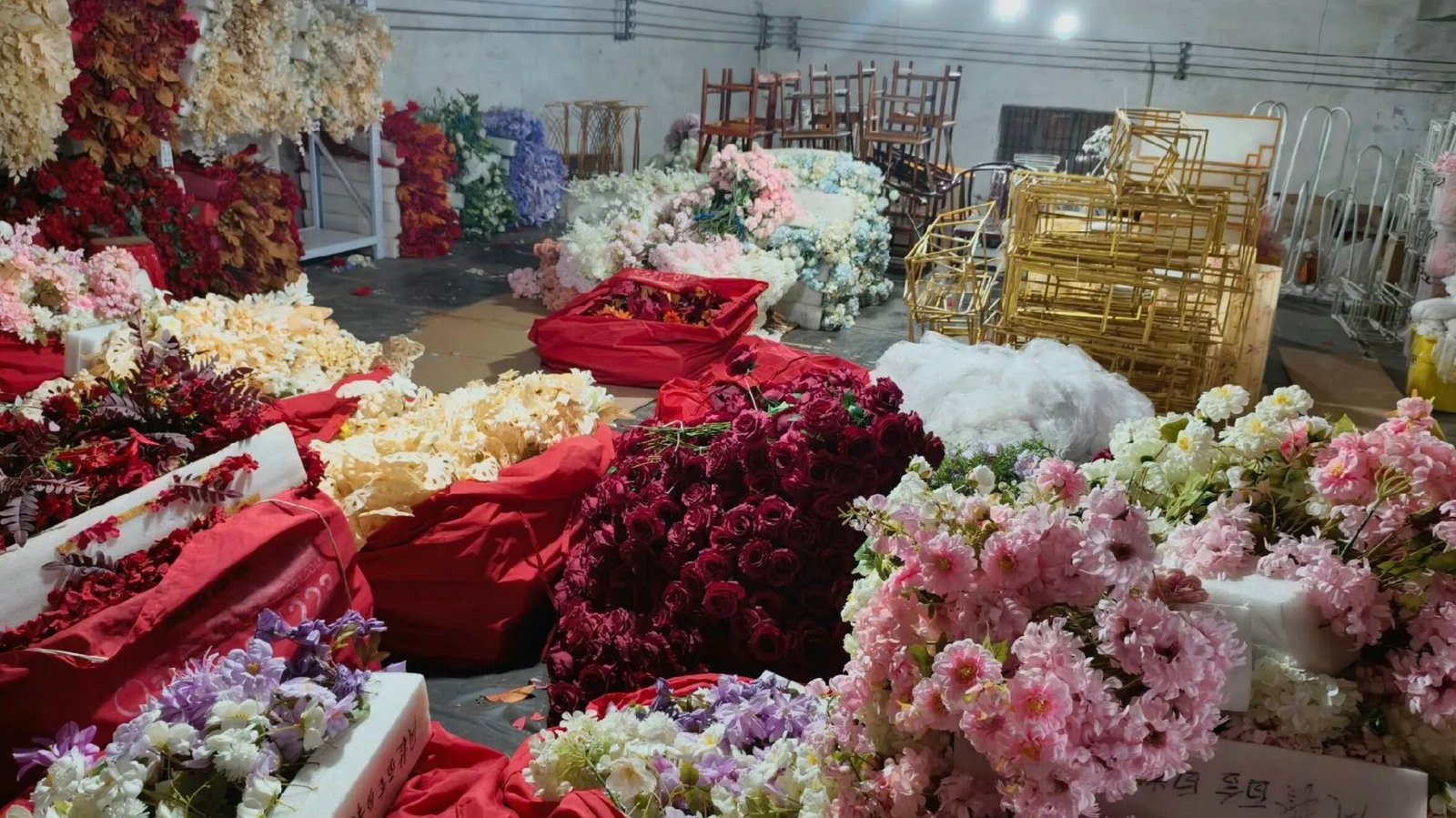
Artificial flower market reports often focus on projected growth rates and future market values.
For buyers sourcing [wholesale artificial flowers], customs data can provide a more practical view of market demand and supply concentration. It shows how much product is actually entering a major market, which material categories account for the trade, and how concentrated the supply chain is by country.
The latest complete 2024 trade data available through the World Bank’s WITS database shows that the United States imported more than US$1.14 billion of artificial flowers, foliage, fruit, parts, and related articles under HS codes 670210 and 670290.
Approximately US$1.10 billion of this value came from China.
These figures do not represent artificial flower stems alone. The product categories also include artificial foliage, fruit, components, and articles made from artificial botanical materials. Nevertheless, the data provides a useful picture of the scale and structure of the artificial botanical import market.
Understanding HS Codes 670210 and 670290
Artificial flower products are commonly classified within HS heading 6702.
The heading covers artificial flowers, foliage, fruit, their parts, and articles made from those products.
The two six-digit categories most relevant to wholesale buyers are:
HS 670210: Products Made of Plastics
This category covers artificial flowers, foliage, fruit, parts, and related articles made from materials other than those classified as plastics.
Products containing textile petals, man-made fibers, feathers, coated materials, or other constructions may fall within this group, depending on their composition and the applicable customs rules.
Final classification should be determined from the complete product construction rather than the product name alone. Importers should confirm the correct classification with their customs broker before shipment.
U.S. Artificial Flower Import Data for 2024
The following table combines the two relevant six-digit categories reported by the United States.
| HS code | Product group | U.S. imports from all countries | Imports from China | China share |
| 670210 | Of plastics | US$663.45 million | US$633.78 million | 95.5% |
| 670290 | Of other materials | US$482.68 million | US$467.93 million | 96.9% |
| Combined | Both categories | US$1.146 billion | US$1.102 billion | 96.1% |
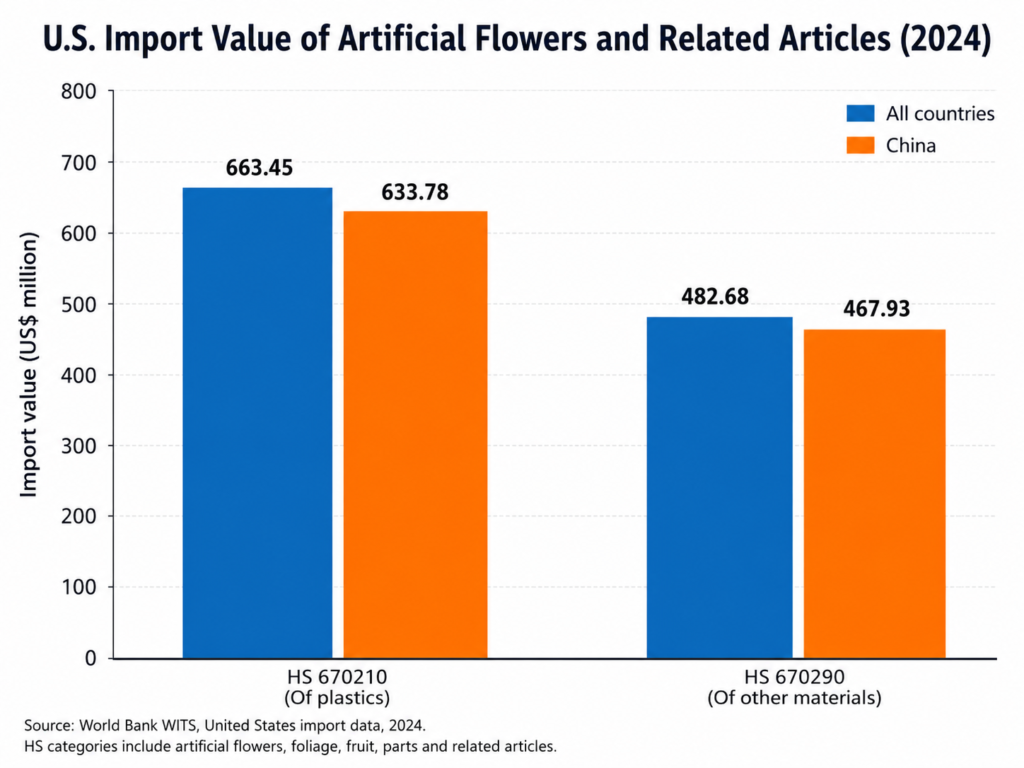
The United States also imported approximately 137.3 million kilograms across the two categories. About 131.8 million kilograms were reported as originating from China.
This does not prove that every artificial flower sold in the United States is manufactured in China. It does show that China accounted for an exceptionally high share of reported U.S. imports within these two product groups.
Plastics Accounted for the Larger Import Category
HS 670210 represented approximately 57.9% of the combined import value, while HS 670290 represented approximately 42.1%.
This does not mean that nearly 58% of finished artificial flowers are completely plastic.
Many commercial artificial flowers use several materials in the same product. A flower stem may contain polyester petals, molded plastic leaves, an internal metal wire, plastic stem coating, glue, wrapping material, and printed packaging.
Customs classification depends on the applicable classification rules and the construction of the imported article.
For buyers, the data indicates that molded and plastic-based botanical products remain commercially important, but textile and other material constructions also represent a substantial part of the import market.
What China’s 96% Share Means for Wholesale Buyers
The data reveals both advantages and risks.
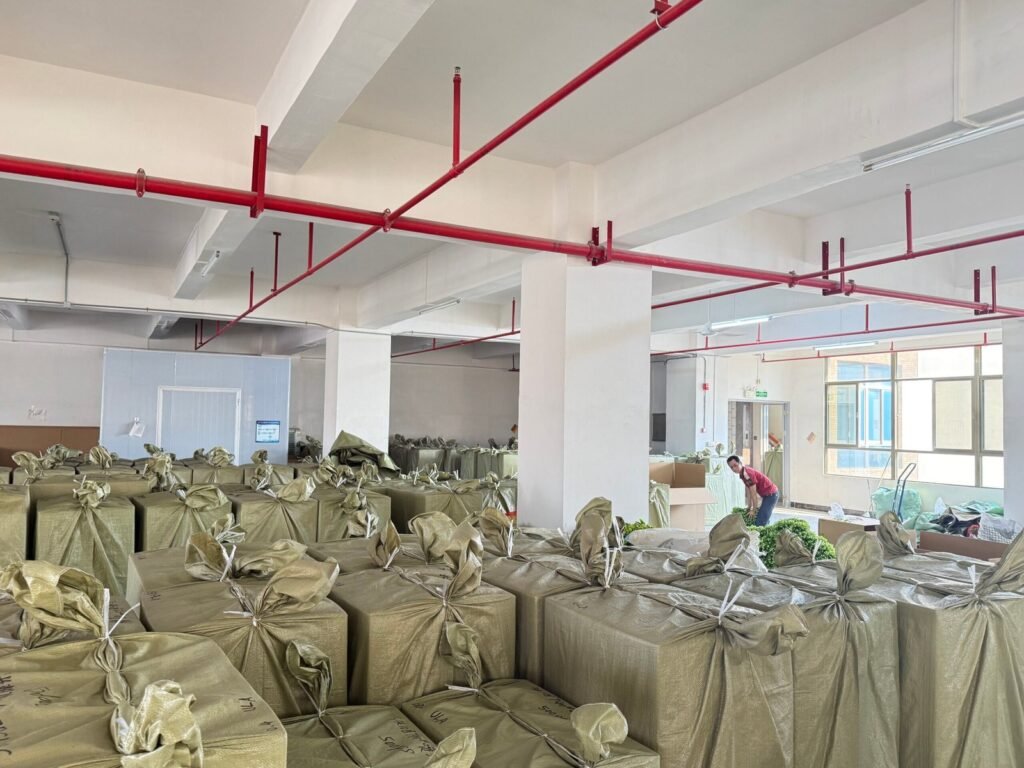
1. China Has a Deep Artificial Botanical Supply Chain
A high import share normally reflects more than low labor cost.
Artificial flower manufacturing depends on access to:
- Petal and textile processing
- Plastic molding
- Wire and stem components
- Hand coloring and finishing
- Flower-head assembly
- Packaging production
- Printing and labeling
- Export consolidation
- Product-development labor
Working with an experienced [artificial flower manufacturer in China] can help buyers coordinate different materials, product categories, packaging options, and price levels.
This is especially useful for wholesalers developing coordinated collections rather than purchasing one individual flower style.
2. Product Similarity Is a Commercial Risk
A large and mature supply base also means that many importers can access similar catalog products.
Changing only a product label may not create meaningful differentiation.
Buyers can create stronger differentiation through [private label artificial flowers], custom colors, packaging, product combinations, and exclusive development.
- Exclusive color combinations
- Different flower-head sizes
- Improved petal coloring
- Coordinated flower and greenery collections
- Custom stem lengths
- Retail-ready packaging
- Branded hangtags and labels
- Marketplace packaging
- Exclusive arrangements
- Controlled material and quality specifications
Private-label value comes from the complete product system, not only from adding a logo.
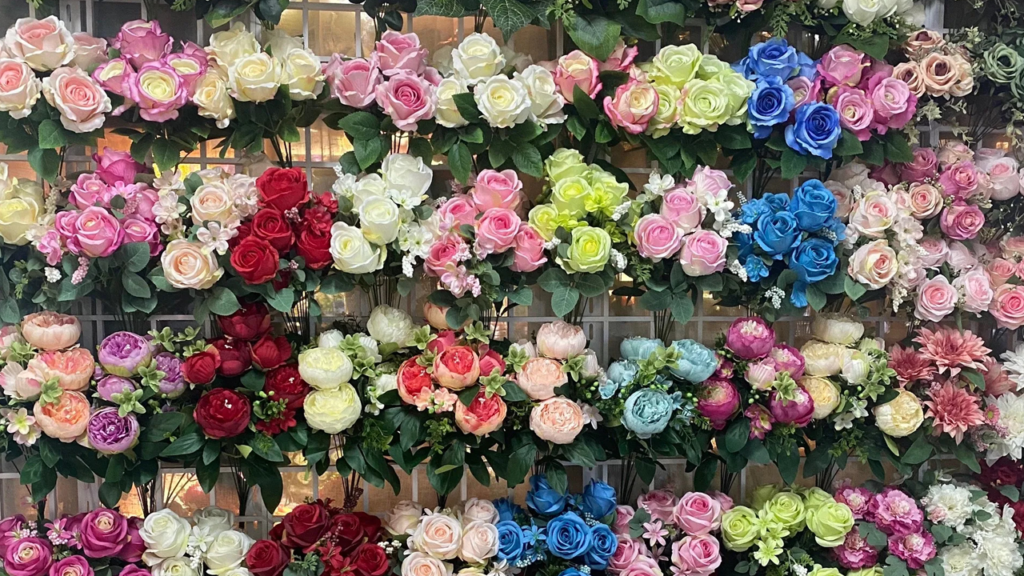
3. Supplier Selection Still Matters
A dominant manufacturing country does not mean every supplier has the same capability.
Buyers requiring custom colors, structures, packaging, or original development should evaluate the supplier’s [OEM and ODM manufacturing] capabilities.
Wholesale buyers should evaluate the individual factory rather than relying only on the country of origin.
Important questions include:
- Which production processes are completed in-house?
- Which components are outsourced?
- How are colors controlled between batches?
- Can the supplier reproduce an approved sample?
- Are packaging dimensions confirmed before ordering?
- Can the buyer arrange a third-party inspection?
- How are defects, shortages, or incorrect labels handled?
- Who owns custom molds and packaging artwork?
Why Import Value Does Not Equal Market Size
Import data and market-size reports measure different things.
Import data records goods entering a country under specific customs classifications. It normally reflects declared trade value rather than final retail sales.
Retail market estimates may include:
- Importer margins
- Distributor margins
- Retail markups
- Domestic production
- Installation services
- Floral design work
- Project management
- Products placed under different customs codes
For this reason, the US$1.146 billion figure should be described as the combined U.S. import value of HS 670210 and 670290—not as the exact size of the American artificial flower retail market.
Using the correct description makes the article more credible and prevents an industry data point from being exaggerated.
What Current Design Demand Suggests
Trade data shows supply volume, but it does not fully explain why buyers purchase the products.
In 2026, design coverage has increasingly treated premium faux flowers as decorative objects rather than cheap substitutes for fresh flowers. Improvements in coloring, materials, asymmetry, and botanical detail are contributing to greater acceptance in interiors and events.
For wholesale buyers, this suggests that the opportunity is not limited to competing on the lowest unit price.
No. Real-touch is generally a descriptive term for a lifelike visual and tactile effect. The actual construction may involve PU, latex, PEVA, coated fabric, or other materials.
Potential market positions include:
- Entry-level decorative stems
- Mid-market coordinated collections
- Premium real-touch flowers
- Wedding and event products
- Rental-friendly installations
- Hospitality arrangements
- Seasonal wreaths and garlands
- Retail-ready bouquets
- E-commerce packaging sets
The strongest assortment normally combines products with different commercial functions instead of placing every SKU at the same quality and price level.
Realism Is Becoming More Important
Modern buyers increasingly evaluate artificial flowers at close range and through high-resolution online product images.
Realism depends on several elements working together:
- Natural color gradients
- Controlled surface shine
- Varied petal positioning
- Accurate flower-head proportions
- Botanical leaf shapes
- Covered attachment points
- Suitable stem flexibility
- Realistic imperfections
- Consistency between photography and delivered products
A premium material cannot compensate for poor coloring or weak assembly.
Likewise, a well-designed polyester flower can outperform a more expensive coated flower when its color, construction, packing, and application are better suited to the customer.
Sustainability Claims Require Care
Artificial flowers are frequently described as sustainable because they can be reused and do not require water, refrigeration, or repeated replacement in the same way as fresh flowers.
However, many artificial flowers contain plastics, mixed materials, adhesives, metal wire, coatings, and packaging. Their environmental performance depends on manufacturing, transport, useful life, reuse, and disposal.
Recent reporting on sustainable floral alternatives has also noted that the environmental case for imported plastic-based artificial flowers is not automatically clear.
B2B sellers should therefore avoid unsupported claims such as:
- Completely eco-friendly
- Zero environmental impact
- Fully recyclable
- Sustainable in every application
More defensible statements include:
- Designed for repeated use
- Suitable for long-term displays
- Helps reduce replacement frequency
- Reusable for seasonal and event installations
- Packaging options can be reviewed according to buyer requirements
Any recycled-content or recyclability claim should be supported by specific product and material documentation.
Practical Lessons for Wholesalers and Importers
The trade data provides several useful sourcing lessons.
Build a Collection, Not a Random SKU List
A collection should have a clear customer, application, color direction, price level, and sales channel.
For example, a wedding collection may combine focal flowers, filler flowers, foliage, garlands, bouquets, and installation components.
A retail collection may require coordinated stems, barcode labels, packaging dimensions, display quantities, and reorder planning.
Compare Landed Cost
The factory price is only one part of the commercial cost.
Buyers should compare:
- Unit price
- Inner and master packing
- Carton dimensions
- Total CBM
- Gross weight
- Inland export charges
- International freight
- Customs duty
- Inspection cost
- Destination handling
- Damage and rework risk
Artificial flowers are often lightweight but bulky. A cheaper product can produce a higher landed cost when its packaging is inefficient.
Approve Both Product and Packaging Samples
The approved product sample should record:
- Color
- Materials
- Total dimensions
- Flower-head size
- Branch and leaf count
- Stem construction
- Surface finish
- Attachment method
The packed sample should also be reviewed for compression, deformation, shape recovery, barcode placement, and carton protection.
Plan for Repeat Orders
Buyers should ask how the supplier records approved colors, materials, packaging, and construction.
A successful initial order has limited value if the same product cannot be reproduced consistently six months later.
How PJTL Supports Wholesale Buyers
PJTL Flowers supplies artificial flowers, greenery, plants, wreaths, garlands, and seasonal decorations for wholesalers, retailers, private-label brands, and e-commerce buyers.
The company supports custom colors, materials, sizes, packaging, branding, and OEM/ODM development. Its current ordering information lists sample preparation of fewer than five working days for applicable projects, approximately 7–15 days for standard production, and approximately 15–25 days for customized or OEM production. Final timing depends on the product, quantity, materials, packaging, and production schedule.
Buyers requesting a quotation should provide:
Target market: Sales channel: Product or reference images: Estimated quantity by SKU: Required colors: Dimensions: Preferred materials: Packaging requirements: Logo and barcode requirements: Destination country or port: Required arrival date: Testing or documentation requirements:
A detailed request allows the factory to recommend a more appropriate product, packing method, sample plan, and quotation structure.
Conclusion
U.S. import data confirms that artificial botanical products represent a substantial international trade category.
In 2024, the United States imported approximately US$1.146 billion under HS codes 670210 and 670290, with approximately 96.1% of the combined value coming from China.
The figures demonstrate the depth of China’s artificial flower and foliage supply chain, but they do not remove the need for careful supplier evaluation.
For wholesale buyers, the commercial advantage comes from selecting the right materials, building a coherent collection, controlling the approved sample, optimizing packaging, calculating landed cost, and establishing reliable repeat-order standards.
Frequently Asked Questions
How large is the U.S. artificial flower import market?
The United States imported approximately US$1.146 billion under HS 670210 and 670290 in 2024. The categories include artificial flowers, foliage, fruit, parts, and related articles, so the figure should not be presented as an artificial flower-only retail market value.
What is the HS code for artificial flowers?
Artificial flowers and related botanical articles commonly fall under heading 6702. HS 670210 covers products of plastics, while HS 670290 covers products of other materials. The final classification depends on the product construction and destination-country rules.
What percentage of U.S. imports came from China?
China accounted for approximately 95.5% of U.S. imports under HS 670210 and approximately 96.9% under HS 670290 in 2024. Combined, China represented approximately 96.1% of the reported import value.
Does a high China import share mean every supplier is similar?
No. Factories differ in product development, materials, quality control, packaging, communication, production capacity, documentation, and repeat-order consistency.
What should wholesale buyers compare before ordering?
Compare the approved sample, material specification, product dimensions, MOQ, packaging, carton CBM, landed cost, quality-control method, production time, payment terms, and defect-handling process.
Planning a wholesale or private-label artificial flower collection? [Request a factory-direct quotation from PJTL].
Ready to Start?
Tell us what you’re looking for. We’ll get back to you within 24 hours with pricing, availability, and a sample offer.