
Home > Blog > Wholesale Buying Guide > What U.S. Import Data Reveals About the Artificial Flower Market in 2026
How to Pack Artificial Flowers for Export: Carton CBM, Dimensional Weight and Damage Prevention
By PJTL | July 2026
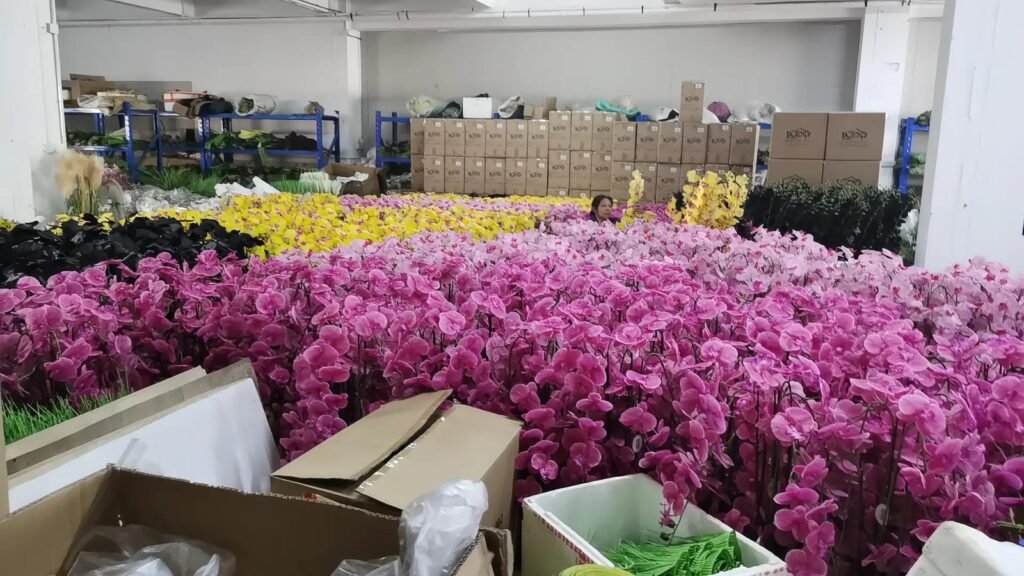
Artificial flower packaging is often treated as the final step after the product and price have already been confirmed.
For wholesale buyers, that is too late.
The packing method affects product shape, carton volume, freight cost, warehouse handling, barcode accuracy, retail presentation and the amount of work required after the shipment arrives.Buyers can also review our [wholesale buying solutions] for sourcing, samples, MOQ, packaging and international delivery support.
Artificial flowers are especially sensitive to packaging decisions because they are generally lightweight but occupy considerable space. Flower heads can be compressed, stems can bend, leaves can crease and surface coatings can rub against other products during transport.
According to 2024 World Bank WITS data, the United States imported approximately US$1.146 billion and 137.3 million kilograms of artificial flowers, foliage, fruit, parts and related articles under HS codes 670210 and 670290. Approximately US$1.102 billion of that value came from China. These customs categories include more than finished artificial flower stems, but they demonstrate the scale of cross-border artificial botanical shipments.
A reliable packing plan must therefore balance three commercial objectives:
- Protect the product during handling and transport.
- Control carton volume and chargeable weight.
- Match the buyer’s retail, wholesale or e-commerce fulfillment requirements.
Why Artificial Flower Packaging Affects Landed Cost
The factory unit price does not include every cost created by the product.
A flower stem may have a competitive purchase price but still become commercially expensive if:
- Too few pieces fit in each carton.
- The carton contains excessive empty space.
- Flower heads require expensive protective packaging.
- The shipment is charged by dimensional weight.
- Products arrive compressed and require manual reshaping.
- Labels or barcodes must be replaced at the destination.
- Damaged products become unsellable.
- Cartons are unsuitable for warehouse or marketplace handling.
For this reason, buyers should request carton dimensions, pieces per carton, gross weight and total CBM before approving a bulk order.
This does not prove that every artificial flower sold in the United States is manufactured in China. It does show that China accounted for an exceptionally high share of reported U.S. imports within these two product groups.
1. Define the Sales Channel Before Designing the Packaging
There is no single packing method suitable for every buyer
Wholesale and distribution packing
Wholesale buyers normally prioritize:
- Efficient carton utilization
- Stable export cartons
- Easy SKU identification
- Mixed-SKU carton planning
- Fast warehouse receiving
- Low repacking requirements
Products may be packed in polybags, inner cartons or grouped bundles, depending on their shape and value.
Retail-ready packing
Retailers may also require:
- Branded sleeves or boxes
- Hangtags
- Barcodes
- Product information labels
- Shelf-ready display packs
- Inner packs containing a fixed retail quantity
Retail packaging increases presentation value, but it can also increase carton volume and packaging MOQ.
E-commerce packing
Online sellers need to consider both the master export carton and the individual customer parcel.
The product may need:
- Individual protective packaging
- Barcode or SKU labels
- Packaging suitable for parcel handling
- Clear unpacking or reshaping instructions
- Compact dimensions
- Protection against bending and crushing
- A consistent photographed appearance after unpacking
PJTL’s current e-commerce solution includes barcode application, marketplace-oriented packaging and export-carton optimization, so this article can naturally link to the E-commerce Sellers page.
Buyers selling through Amazon, Shopify, Etsy or Walmart can review our [artificial flower solutions for e-commerce sellers] for barcode labeling, marketplace packaging and trial-order support.
2. Match the Packing Method to the Product Form
Different artificial flower products fail in different ways during transport.
| Product type | Main packing risk | Common packing direction |
| Flower stems and branches | Bent stems, crushed flower heads, tangled branches | Aligned bundles, head protection and controlled carton length |
| Flower bouquets | Flattened arrangement, displaced flowers and compressed wrapping | Individual sleeve or bag, fixed arrangement shape and head clearance |
| Flower bushes | Tangled branches and uneven compression | Folded or nested carefully with consistent bundle quantity |
| Greenery stems | Creased leaves and permanent folding marks | Layered packing with controlled pressure |
| Garlands and vines | Tangling, flattened tips and damaged connectors | Even coiling or controlled folding |
| Wreaths | Loss of roundness and crushed decorations | Inner support, individual box or shaped protection |
| Potted plants | Broken pots, loose filler and damaged foliage | Pot fixation, base protection and separate head clearance |
| Flower heads and components | Deformation, color transfer and mixed-SKU errors | Divided bags, trays, inner boxes or counted packs |
The packaging should be developed around the product’s weakest point rather than using the same carton structure for every SKU.

3. Approve a Packed Sample, Not Only an Unpacked Sample
A buyer may approve a flower that looks correct on a showroom table but discover that it behaves differently after being packed for several days.
Before bulk production, the approved sample should be tested using the intended packing method.
The review should include:
- Product appearance before packing
- Packing orientation
- Number of pieces per inner pack
- Number of pieces per carton
- Compression level
- Product appearance immediately after unpacking
- Product appearance after normal reshaping
- Broken or loose components
- Surface rubbing or color transfer
- Condition of the retail packaging
- Time required to restore the intended shape
If the product requires extensive steaming, bending or manual adjustment after arrival, the packing method may be too aggressive even if no components are technically broken.
For private-label projects, the product sample and packaging sample should be approved together. Buyers requiring branded boxes, hangtags, labels or custom product development can review our [OEM and private-label manufacturing support].
4. Protect Flower Heads Without Creating Excessive Empty Space
The most fragile area is often the flower head.
Common damage includes:
- Flattened petals
- Bent petal edges
- Detached flower heads
- Surface scratches
- Crushed buds
- Glue separation
- Color transfer between dark and light products
Protection options may include:
- Positioning flower heads in alternating directions
- Using paper or soft protective layers between products
- Providing head clearance inside the carton
- Using formed trays or inner boxes for higher-value products
- Separating coated or real-touch surfaces
- Securing large flower heads so they do not move freely
- Limiting the pressure applied by upper carton layers
More protection is not automatically better. Excessive paper, foam or individual boxes can increase volume and cost without producing a meaningful improvement.
The packaging should use the minimum material necessary to meet the agreed arrival standard.
5. Control Stem Length and Carton Dimensions
Long artificial flower branches can create inefficient cartons because the carton length is determined by the longest product dimension.
Before finalizing a design, buyers can discuss whether the product can be:
- Packed diagonally
- Bent safely at an agreed point
- Produced with a detachable stem
- Packed in two sections
- Nested with related products
- Bundled in alternating directions
- Supplied in a shorter retail configuration
A detachable or foldable design may reduce shipping volume, but it must not weaken the connection or create an inconvenient assembly process for the end customer.
The buyer should compare the freight saving against the additional component, assembly and packaging cost.
6. Calculate Carton CBM Before Confirming the Order
For sea freight and many warehouse calculations, buyers need the total cubic volume of the shipment.
The basic calculation is:
- Carton CBM =
- Carton length in metres
- × carton width in metres
- × carton height in metres
For example, a carton measuring: 80 cm × 40 cm × 30 cm
is converted to metres: 0.80 × 0.40 × 0.30 = 0.096 CBM per carton
If the order contains 100 cartons: 0.096 × 100 = 9.6 CBM
Buyers should request the following before confirming freight:
- Pieces per carton:
- Number of cartons:
- Carton length:
- Carton width:
- Carton height:
- CBM per carton:
- Total CBM:
- Net weight:
- Gross weight:
Do not calculate freight only from the product weight. Artificial flowers frequently occupy more transport space than their weight suggests.
7. Understand Dimensional Weight for Express and Air Shipments
Express couriers and air-freight providers may calculate charges using the greater of actual weight and dimensional weight.
One UPS packaging guide states the following dimensional-weight calculation for the covered service:
- Dimensional weight in kg =
- Length in cm × Width in cm × Height in cm ÷ 5000
The guide also states that the greater of actual and dimensional weight is used as the billable weight. Carrier rules, divisors and service conditions can differ, so buyers must confirm the current formula with the selected carrier or forwarder.
Using the same 80 × 40 × 30 cm carton: 80 × 40 × 30 ÷ 5000 = 19.2 kg
If the carton’s actual gross weight is only 7 kg, the shipment may still be charged according to approximately 19.2 kg under that dimensional-weight rule.
This is why reducing unnecessary carton height can create a larger saving than reducing a small amount of product weight.
8. Avoid Overcompression
Compressing artificial flowers can reduce CBM, but excessive compression creates hidden costs.
Possible consequences include:
- Petals that do not recover
- Permanent leaf creases
- Misshapen flower heads
- Bent wires
- Loose attachments
- Damaged coatings
- Increased customer complaints
- Additional warehouse labor
- More returns or unsellable inventory
The lowest-CBM carton is not necessarily the most profitable carton.
A better packing decision compares:
- Freight saving
- versus
- damage risk + reshaping labor + customer-return risk
For lower-value decorative stems, some reshaping may be commercially acceptable. For premium real-touch flowers, bridal products or retail-ready bouquets, the allowable compression should normally be lower.
9. Plan Inner Packs and Mixed-SKU Cartons Carefully
A master carton may contain:
- One SKU and one color
- One SKU in several colors
- Several related SKUs
- Retail inner packs
- Mixed assortment packs
Mixed packing can help buyers test more products, but it increases the risk of:
- Quantity errors
- Incorrect labels
- Slow warehouse receiving
- Unbalanced carton weight
- Difficult stock counting
- Color or SKU confusion
Each inner pack should be clearly identified with the agreed SKU, color and quantity.
When several products are packed in one carton, the packing list should show the actual assortment rather than only the total number of pieces.
10. Confirm Barcodes, Labels and Carton Marks
Packaging errors can delay warehouse receiving even when the product itself is correct.
Before production, confirm:
Product-level information
- Product name
- SKU
- Color
- Barcode
- Country-of-origin marking where required
- Private-label brand
- Retail quantity
- Product or safety information where applicable
Master-carton information
- Buyer name or purchase-order number
- SKU
- Color
- Quantity
- Carton number
- Total carton count
- Net weight
- Gross weight
- Carton dimensions
- Destination mark
- Handling symbols where required
Barcode files should be provided in an agreed format and checked before mass printing.
The buyer should also confirm whether labels are applied to the product, inner pack, retail box, master carton or several levels of packaging.
11. Inspect the Packing Before Shipment
A practical packing inspection should include:
| Check | What to verify |
| Carton dimensions | Match the approved carton plan and freight quotation |
| Carton strength | Suitable for product weight and shipping method |
| Pieces per carton | Match purchase order and packing list |
| Product orientation | Flower heads and stems positioned correctly |
| Compression | Within the approved limit |
| Inner packing | Correct bags, sleeves, boxes or separators |
| Labels | Correct SKU, color, barcode and quantity |
| Carton marks | Match buyer instructions |
| Gross weight | Consistent with shipping documents |
| Appearance after unpacking | Product can recover to the approved shape |
| Carton count | Matches final packing list |
Packaging inspection should be completed against the approved product and packed sample. See how PJTL manages [artificial flower factory quality control] from materials and production to final packing.
For larger orders, buyers may also request pre-shipment photographs, packing videos or a third-party inspection.
12. Compare Freight Quotations Using the Same Packing Data
Two suppliers cannot be compared accurately if they quote different carton plans.
One supplier may provide a lower unit price but use larger cartons. Another may have a slightly higher product price but fit more sellable units into each cubic metre.
A useful comparison should include:
- Product price
- Pieces per carton
- Carton dimensions
- Gross weight
- Total cartons
- Total CBM
- Trade term
- Origin charges
- International freight
- Destination charges
- Duty and taxes
- Expected damage or rework allowance
Incoterms® do not set the product price, but they help define buyer and seller responsibilities, costs, risk and obligations. The ICC currently publishes 11 Incoterms® 2020 rules.
The exact term and named location should be written clearly, for example: FOB [named port], Incoterms® 2020
For containerized shipments, the ICC notes that FCA may sometimes be more appropriate than FOB because the seller normally delivers the container to a terminal before it is loaded onto the vessel. Buyers should discuss the appropriate term with their forwarder instead of selecting a term only because it is commonly used.
Available transport methods, trade terms and order responsibilities vary by project. Review the [PJTL Shipping Policy] before confirming the final shipping arrangement.
13. Include Packaging Requirements in the RFQ
Do not wait until production is complete to discuss packing.
Include the following information in the quotation request:
- Product links or SKUs:
- Quantity per SKU and color:
- Target country:
- Sales channel:
- Shipping method:
- Required retail packaging:
- Pieces per inner pack:
- Barcode requirements:
- Private-label requirements:
- Carton-mark requirements:
- Maximum parcel or carton dimensions:
- Marketplace or warehouse requirements:
- Preferred pieces per carton:
- Required arrival date:
- Special shape-protection requirements:
The supplier may not be able to confirm final carton dimensions before the physical sample and packing test are completed. However, the intended packing direction should be discussed before the product price is finalized.
How PJTL Supports Artificial Flower Packing and Shipping
PJTL is a factory-owning [China artificial flower manufacturer] supplying artificial flowers, greenery, plants, wreaths and seasonal decorations for wholesalers, retailers, private-label brands and e-commerce sellers.
Depending on the project, packaging support may include:
- Standard wholesale packing
- Inner packs
- Custom labels and barcodes
- Private-label packaging
- Export-carton planning
- Mixed-SKU packing
- Retail-ready packaging
- E-commerce-oriented packaging
- Carton marks
- Packing lists
- Sea freight, air freight and express arrangements
PJTL’s current shipping policy supports sea freight, air freight, international express couriers and customer-appointed freight forwarders. The site also lists EXW, FOB, CIF and other mutually agreed trade terms, with final terms confirmed before shipment.
To receive a useful packing and shipping quotation, buyers should send their product list, quantities, destination, sales channel and packaging requirements together.
Conclusion
Artificial flower packaging should be designed at the same time as the product, not after mass production.
The correct packing method protects flower shape, controls CBM, reduces dimensional-weight charges, improves warehouse handling and supports the intended sales channel.
Before placing an order, wholesale buyers should confirm:
- Product and packed samples
- Pieces per inner pack
- Pieces per carton
- Carton dimensions
- Gross weight
- Total CBM
- Dimensional weight where applicable
- Labels and carton marks
- Inspection requirements
- Shipping terms
A lower unit price has limited value if the carton is inefficient, the product arrives deformed or the buyer must rework every unit before selling it.
Frequently Asked Questions
How are artificial flowers normally packed for export?
Packing depends on the product. Flower stems may be bundled and layered, bouquets may use sleeves or inner boxes, wreaths may require shape support, and potted products need pot fixation and head clearance.
What is CBM?
CBM means cubic metre. It measures shipment volume and is calculated by multiplying carton length, width and height in metres.
Why are artificial flowers expensive to ship by air?
Artificial flowers are generally lightweight but bulky. Air and express services may charge according to dimensional weight when it is greater than the actual weight.
Should artificial flowers be compressed to reduce freight cost?
Moderate compression may be acceptable for some products, but excessive compression can permanently damage petals, leaves, stems and coatings. The packed sample should be tested before bulk production.
What packaging information should I request from the supplier?
Request pieces per carton, carton dimensions, carton count, total CBM, net weight, gross weight, inner-pack details, barcode placement and carton marks.
Can retail and private-label packaging be customized?
Yes, depending on the product, quantity and packaging material. Printed boxes, sleeves, hangtags and labels may have separate MOQ and preparation requirements.
Should I use FOB, CIF or another trade term?
The appropriate term depends on the transport mode, forwarder arrangement and allocation of cost and risk. Confirm the exact Incoterms® rule and named place with the supplier and freight forwarder before ordering.
Ready to Start?
Tell us what you’re looking for. We’ll get back to you within 24 hours with pricing, availability, and a sample offer.