
Home > Blog > Product Materials Guide > Artificial Flower Materials Guide: Silk, PE, PU, Latex and Real-Touch Explained
Artificial Flower Materials Guide: Silk, PE, PU, Latex and Real-Touch Explained
By PJTL | July 2026
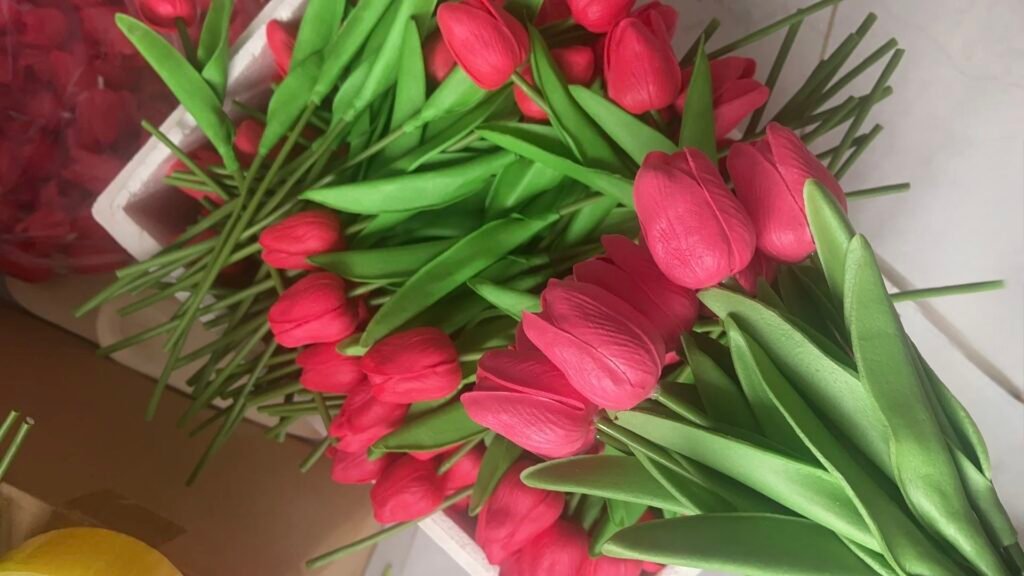
Choosing artificial flowers for a wholesale collection is not only about color, flower type, or unit price.
The material affects how the product looks in photographs, how it feels when handled, how well it recovers after shipping, how consistently it can be reproduced, and which customer group it is suitable for.
This matters because artificial flowers are visual products. Small differences in petal color, flower-head position, stem length, leaf placement, or visible glue can affect how an entire retail collection looks.
In 2024, the United States imported approximately US$663.45 million of artificial flowers, foliage, fruit, and related articles made of plastics under HS 670210. Approximately US$633.78 million of that value came from China. The category includes more than artificial flower stems alone, but it demonstrates the commercial importance of plastic and mixed-material artificial botanical products in international trade.
For wholesalers, distributors, retailers, and e-commerce sellers, there is no single “best” artificial flower material. The correct choice depends on the intended appearance, price position, sales channel, packaging method, and end-use environment.
“Silk” and “Real-Touch” Are Not Complete Material Specifications
Two of the most common terms in the artificial flower industry are “silk flowers” and “real-touch flowers.”
However, neither term automatically tells the buyer exactly what the product is made from.
In modern wholesale production, “silk flower” often refers to a flower with soft textile petals rather than petals made from natural silk. Polyester-based fabric is commonly used because it can be cut, shaped, printed, dyed, and produced consistently at commercial quantities.
“Real-touch” normally describes the intended visual and tactile result. Depending on the product, the effect may be created with PU, latex, PEVA, coated fabric, molded components, or a combination of materials.
Soft-touch and real-touch can overlap, but they are not universal technical specifications. Buyers should request an actual material description and approve a physical sample instead of relying only on the marketing term.
Quick Artificial Flower Material Comparison
| Material | Typical appearance and feel | Common applications | Main advantages | Points buyers should check |
| Polyester fabric | Soft, lightweight and suitable for layered petals | Peonies, hydrangeas, roses, blossoms and wedding flowers | Wide color range, lightweight, flexible and suitable for detailed petal shapes | Fraying, excess shine, flat printing, creasing and color consistency |
| PE | Molded, flexible and capable of holding detailed shapes | Leaves, greenery, stems, succulents and molded flower parts | Durable, water-resistant and suitable for detailed molding | Plastic shine, seam lines, stiffness and UV claims |
| PU | Soft or slightly waxy, depending on formulation and construction | Tulips, orchids, roses and premium-feel petals | Flexible, lightweight and suitable for realistic surface effects | Tackiness, odor, yellowing, surface damage and heat sensitivity |
| Latex or latex coating | Soft, fleshy and natural-feeling surface | Orchids, lilies, calla lilies and premium flower petals | Realistic touch and fuller petal appearance | Odor, surface consistency, aging, sensitivity requirements and storage |
| PVC or PP | More structured and generally firmer | Greenery, seasonal decorations, structural leaves and budget products | Stable shape, efficient production and controlled cost | Hardness, shine, visible molding marks and flexibility |
| EVA or foam | Lightweight and soft | Decorative flowers, craft products and selected flower heads | Low weight, easy shaping and useful for volume | Compression marks, tearing, surface texture and shape recovery |
| Flocking or velvet finish | Fuzzy, matte or decorative surface | Seasonal flowers, berries, leaves, stems and holiday products | Adds texture and reduces plastic appearance | Loose flock, color transfer, dust collection and abrasion |
Most commercial artificial flowers use several materials in one product. For example, a flower may have polyester petals, a molded plastic flower base, printed leaves, an internal steel wire, a plastic-coated stem, glue, and hand-applied coloring.
Polyester Fabric and “Silk-Style” Artificial Flowers
Polyester fabric is widely used for flowers that require soft, thin, or layered petals.
It is particularly suitable for flower types such as:
- Peonies
- Hydrangeas
- Roses
- Cherry blossoms
- Camellias
- Dahlias
- Artificial flower sprays
The realism of a fabric flower depends on more than the fabric itself.
Buyers should also review:
- Crease recovery after packing
- Petal thickness
- Edge cutting and finishing
- Printed veins and color gradients
- Heat shaping
- Petal layering
- Flower-head fullness
- Surface shine
A low-quality fabric flower may have flat color, rough edges, visible threads, excessive shine, or petals that remain creased after shipping.
A better product normally combines suitable fabric with controlled coloring, natural petal positioning, and consistent assembly.
Best suited to
Polyester fabric flowers are suitable for wedding decoration, home décor collections, event installations, wholesale bouquets, and products requiring many color options.
Main buying risk
Do not approve a fabric flower only from edited catalog photographs. Request close-up images in normal lighting and inspect a physical sample for texture, edge finishing, printing, and recovery after compression.
PE Artificial Flowers and Greenery
PE, or polyethylene, is commonly used for molded leaves, flower components, stems, greenery, and artificial plants.
Because PE can be molded, it can reproduce details such as:
- Leaf veins
- Petal curves
- Stem textures
- Bud shapes
- Botanical surface patterns
- Small structural components
PE is generally more resistant to moisture than textile petals and can hold a consistent shape during production.
However, PE quality varies. A poorly designed product may appear too shiny, thick, hard, or uniform. Visible mold lines and unrealistic coloring can also reduce the perceived value.
Best suited to
PE is commonly suitable for artificial greenery, foliage, succulents, molded leaves, potted plants, structural flower parts, and products requiring better moisture resistance.
Main buying risk
Do not assume that all PE products are suitable for permanent outdoor use. If UV resistance is required, ask which material treatment, test method, report, product, and production batch the claim applies to.
PU and Real-Touch Artificial Flowers
PU, or polyurethane, can be used in molded parts, foam structures, coatings, bonding materials, or soft flower components.
Depending on the product design, PU can create a softer and more natural surface than hard molded plastic.
It is often considered for flowers where buyers expect close-up realism, such as:
- Tulips
- Orchids
- Roses
- Calla lilies
- Anthuriums
- Premium bridal flowers
PU products are not automatically identical in quality. The final result depends on the formulation, thickness, coloring, molding, coating, and storage conditions.
Best suited to
PU is suitable for premium retail collections, bridal products, hotel decoration, photography, close-up displays, and products where touch is part of the customer experience.
Main buying risk
Check the sample for surface tackiness, strong odor, inconsistent thickness, color transfer, cracking, yellowing, and deformation after storage or transport.
The buyer should also confirm whether “PU flower” refers to the complete petal material, a surface coating, a foam component, or only one part of the product.
Latex and Latex-Coated Artificial Flowers
Latex or latex-like coatings may be used to create petals with a thicker, fleshy, or more natural feel.
This can work well for flowers that naturally have smooth or substantial petals, including orchids, lilies, anthuriums, tulips, and calla lilies.
Latex-style products may look more realistic when handled, but they can also require more careful storage and quality evaluation than standard fabric flowers.
Best suited to
Latex or coated products are normally positioned for premium arrangements, close-up retail displays, hospitality decoration, bridal products, and higher-value floral collections.
Main buying risk
Buyers should confirm:
- Actual material composition
- Surface odor
- Color consistency
- Coating thickness
- Tackiness
- Packaging method
- Storage recommendations
- Destination-market requirements
The word “latex” should not be used as a complete purchasing specification. A physical approved sample remains necessary.
PVC, PP, EVA, Foam and Supporting Materials
Not every component needs to be soft or real-touch.
PVC, PP, EVA, foam, flock, velvet, wire, paper, and textile wrapping can each perform a specific function within the finished product.
PVC and PP
These materials may be used for structured leaves, greenery, stems, bases, seasonal decorations, and molded components.
They can provide stable shape and production efficiency, but the buyer should check hardness, shine, smell, flexibility, molding lines, and surface detail.
EVA and foam
Foam materials are lightweight and can create volume without adding much weight.
They may be suitable for decorative flower heads, craft products, accessories, and selected event products. The main checks are compression recovery, tearing, surface dents, and edge finishing.
Flocking and velvet
Flocking adds small fibers to a surface, producing a soft or fuzzy texture. Velvet-style surfaces are often used for poinsettias and decorative seasonal flowers.
Check whether the surface sheds, transfers color, attracts excessive dust, or becomes damaged during packing.
Stems, Wire and Attachment Construction
Petal material receives most of the attention, but stem construction can have an equal impact on commercial quality.
A typical artificial flower stem may include:
- Internal iron or steel wire
- Molded plastic coating
- Wrapped paper or floral tape
- Branch connectors
- Glue or mechanical attachments
- Leaf and flower-head fixing points
For event designers and florists, the stem should normally bend and hold the desired position without breaking or exposing the wire.
For e-commerce sellers, the stem may also need to survive folding, parcel delivery, and customer reshaping.
Check:
- Wire thickness
- Bend resistance
- Stem recovery
- Exposed wire
- Loose heads or leaves
- Visible glue
- Sharp edges
- Connection strength
The material specification should cover the complete product construction, not only the petals.
Choose Materials According to the Sales Channel
Wholesale distributors
Distributors usually need a balanced collection covering several price levels. A combination of fabric flowers, molded greenery, and selected real-touch products provides more flexibility than using one material for every SKU.
Retail stores
Retail buyers should consider shelf appearance, handling, color consistency, barcode placement, packaging, and the amount of reshaping required after unpacking.
E-commerce sellers
Online products need strong photograph-to-product consistency and packaging that protects the shape during parcel delivery.
Lightweight fabric flowers may reduce weight, but they must recover properly after compression. PU and coated flowers may offer a premium appearance but may require more careful packing.
Wedding and event suppliers
Wedding flowers need realistic color, flexible stems, fullness, and close-up appearance. Fabric and PU products can both work, depending on the budget and distance from which the arrangement will be viewed.
Hotels and commercial projects
Commercial buyers should define the intended environment, cleaning requirements, installation method, required testing, and expected service life before selecting materials.
Do not rely on general terms such as “commercial grade,” “fireproof,” “weatherproof,” or “UV resistant” without confirming the exact applicable product and supporting documentation.
8. How to Evaluate an Artificial Flower Material Sample
Before placing a bulk order, complete a consistent sample review.
Visual inspection
Check the product in daylight and indoor lighting.
Review:
- Color accuracy
- Color gradients
- Surface shine
- Printed details
- Petal and leaf shape
- Mold lines
- Visible glue
- Overall balance
Touch inspection
Compare softness, flexibility, thickness, surface feel, and whether the product matches its description.
Bend test
Bend the stem several times under normal handling conditions. Check whether it holds shape, cracks, exposes wire, or becomes loose.
Attachment check
Gently inspect flower heads, leaves, buds, and branches to confirm that they remain properly attached.
Packing recovery test
Pack the sample using the intended production method. Leave it packed for an agreed period, unpack it, and check how much reshaping is required.
Surface and odor review
Check for tackiness, strong odor, coating transfer, dust, staining, or surface damage.
Comparison with approved sample
Record the sample code, material, dimensions, color, construction, and packaging. This approved sample should become the reference for bulk production.
Material Information to Include in an RFQ
Instead of writing “I need high-quality silk flowers,” send a more specific request.
Product type:
Reference images:
Target market:
Sales channel:
Intended use:
Required appearance:
Required touch or surface feel:
Petal material:
Leaf material:
Stem construction:
Total length:
Flower-head diameter:
Color or Pantone reference:
Indoor or outdoor use:
Required testing:
Packing method:
Quantity per SKU and color:
Target price position:
Required delivery date:
The buyer does not need to select every technical material independently. A qualified manufacturer can recommend a construction based on the desired result, application, budget, and order quantity.
How Materials Affect Price and MOQ
Material is only one part of the product cost.
The quotation may also be affected by:
- Flower-head size
- Number of petals and leaves
- Color complexity
- Hand coloring
- Molded components
- Stem and wire construction
- Assembly labor
- Custom molds
- Packaging
- Order quantity
- Number of colors
An expensive material does not guarantee a better commercial product. A well-designed polyester flower may perform better for a wedding installation than a heavy real-touch flower. A molded PE leaf may be more suitable for greenery than a soft fabric alternative.
MOQ should also be confirmed separately for the finished product, custom colors, printed packaging, specially prepared materials, and new molds.
Selecting Artificial Flower Materials with PJTL
PJTL selects materials according to the approved product specification, including the required texture, color, appearance, and durability. Custom colors, sizes, materials, and private-label packaging are available according to the individual project.
To receive a more accurate recommendation, buyers should send:
- Product or reference images
- Target market
- Sales channel
- Required quantity
- Preferred appearance and touch
- Packaging requirements
- Destination country
- Required delivery date
The correct material is not simply the softest or most expensive option. It is the material and construction that best match the product design, customer expectation, shipping method, and target price.
Frequently Asked Questions
Are silk artificial flowers made from real silk?
Some specialist products may use natural silk, but most commercial products described as silk flowers use polyester or another textile material. Confirm the actual composition for the specific product.
Is real-touch a material?
No. Real-touch is generally a descriptive term for a lifelike visual and tactile effect. The actual construction may involve PU, latex, PEVA, coated fabric, or other materials.
Which artificial flower material looks most realistic?
There is no universal answer. Fabric can create delicate layered petals, while PU or latex-style materials can create a more natural touch. Coloring, molding, construction, and assembly are as important as the base material.
Which material is best for artificial greenery?
Molded PE and other plastics are commonly used because they can hold detailed leaf shapes and offer practical durability. The correct material depends on the required appearance, flexibility, environment, and price level.
Can artificial flowers be used outdoors?
Only products designed and verified for the intended outdoor conditions should be marketed for outdoor use. Ask for the material specification, intended exposure, applicable testing, and supporting documentation.
Can materials and colors be customized?
Yes. Colors, materials, sizes, construction, and packaging can often be customized, although custom materials, colors, packaging, or molds may have separate minimum production quantities.
Ready to Start?
Tell us what you’re looking for. We’ll get back to you within 24 hours with pricing, availability, and a sample offer.