Home > Blog > Factory Updates > Inside PJTL’s Artificial Flower Factory: How We Control Quality from Materials to Export Packing
Inside PJTL’s Artificial Flower Factory: How We Control Quality from Materials to Export Packing
By PJTL | July 2026
For wholesale buyers, artificial flower quality is not determined by one attractive sample.
The real challenge is whether hundreds or thousands of finished products can maintain the same color, shape, fullness, construction, dimensions, and packaging standard as the approved sample.
This matters because artificial flowers are visual products. Small differences in petal color, flower-head position, stem length, leaf placement, or visible glue can affect how an entire retail collection looks.
In 2024, the United States imported approximately US$1.15 billion of artificial flowers, foliage, fruit, and related articles under HS codes 670210 and 670290. Approximately US$1.10 billion of those imports came from China. These categories include more than flower stems alone, but the figures demonstrate the scale of the international artificial botanical supply chain.
At PJTL, our manufacturing workflow covers material selection, component processing, assembly, quality review, packaging, and export preparation. The objective is not only to produce a realistic sample, but to maintain acceptable consistency throughout the wholesale order.
Why Quality Control Is Different for Artificial Flowers
Artificial flowers contain multiple components that must work together:
- Printed labels, hangtags, sleeves, boxes, and export cartons
- Fabric, PU, PE, plastic, or coated petals and leaves
- Molded flower heads and botanical components
- Internal wire and supporting stems
- Glue, connectors, wrapping, and attachment points
A product can look acceptable from a distance but still have problems that affect wholesale or retail performance.
Typical risks include inconsistent colors, uneven flower heads, exposed wire, loose petals, weak attachments, visible glue, inaccurate dimensions, compressed packaging, and incorrect labels.
For this reason, quality control should not be treated as one final inspection. It must begin before mass production.
Confirming the Product Requirements
The first quality-control step is confirming what the buyer actually expects.
Before sampling or production, the project should define:
- Product style and intended use
- Total stem or branch length
- Flower-head diameter
- Number of flower heads, leaves, and branches
- Required material and surface feel
- Color reference
- Stem flexibility
- Packaging method
- Pieces per inner pack and carton
- Logo, barcode, hangtag, and carton-mark requirements
- Target market and sales channel
A product designed for an e-commerce parcel may require different packaging from a product designed for a retail display, wedding project, or wholesale showroom.
When the requirements are clear at the beginning, the supplier can recommend suitable materials, construction, packing methods, and production solutions.
Preparing and Approving the Sample
The approved sample is the main reference for bulk production.
During sample approval, buyers should review more than the overall appearance. Important details include:
- Packed appearance after unpacking
- Color under natural and indoor lighting
- Total dimensions
- Flower-head size and shape
- Petal and leaf positioning
- Product fullness
- Stem strength and flexibility
- Material texture and surface finish
- Visible glue or exposed wire
- Attachment strength
The approved sample should be photographed and recorded with its product code, dimensions, color, materials, and packaging instructions.
For customized projects, the packaging sample should also be approved before mass production. This is particularly important when the order includes private-label boxes, sleeves, hangtags, barcode labels, or marketplace-ready packaging.
PJTL currently states that sample preparation can normally be completed in fewer than five working days, subject to the product and customization requirements.
Reviewing Artificial Flower Materials
Material selection affects appearance, touch, durability, packing recovery, and production consistency.
Different artificial flower styles may use textile petals, molded plastic leaves, PU-coated surfaces, PE botanical components, internal wire, or combinations of several materials.
The material review should consider:
Color consistency
Petals and leaves should follow the approved color direction. Buyers ordering several related SKUs should also confirm whether the colors need to coordinate across the complete collection.
Surface appearance
The level of gloss, printed pattern, vein detail, edge finishing, and surface texture can significantly affect realism.
Shape recovery
Flowers may be compressed during packing and transport. Materials should be reviewed for how well they recover after unpacking and reshaping.
Stem construction
The wire and outer stem material should provide the required support while remaining suitable for bending, arranging, or display.
Attachment compatibility
Flower heads, leaves, stems, and branches must be compatible with the selected assembly method. A realistic component is not commercially useful if it becomes loose during handling or transport.
PJTL’s current factory process identifies material selection as the first stage, followed by production, product processing, quality control, packaging, and shipping.
Component Processing and Assembly
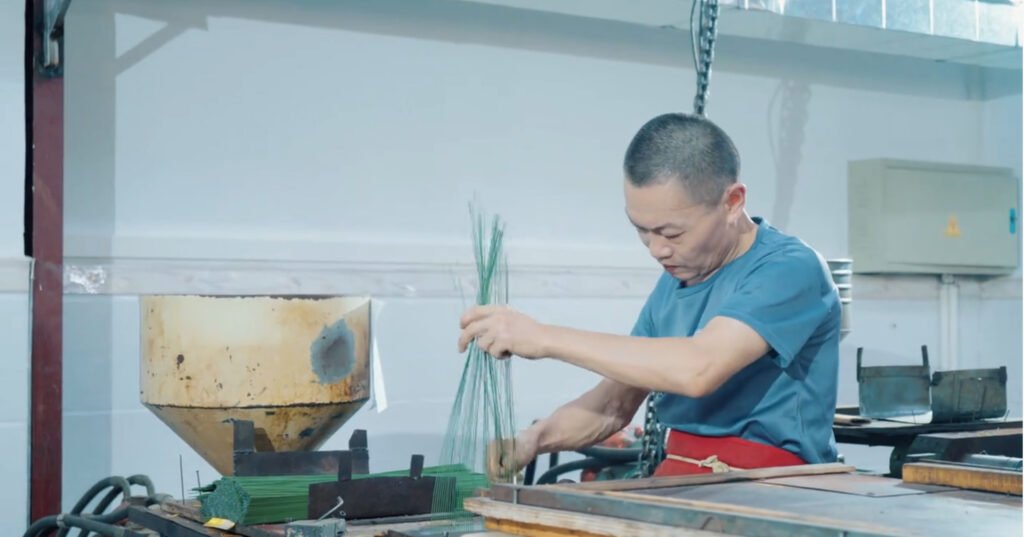
Artificial flower manufacturing combines machine-supported component processing with manual assembly and finishing.
Depending on the product, the workflow may include:
- Completing the final arrangement or product structure
- Preparing or shaping petals, leaves, and molded components
- Producing or preparing stems and branches
- Applying color, printing, coating, or textural details
- Connecting flower heads, petals, leaves, and stems
- Adjusting the shape and position of each component
During this stage, operators need a clear reference for the approved shape and construction.
The main objective is repeatability. A flower should not become noticeably thinner, shorter, less balanced, or differently colored when production moves from the sample stage to the bulk order
In-Process Quality Checks
Waiting until the complete order is finished creates unnecessary risk.
In-process checking allows problems to be identified before they affect the entire production batch.
Typical in-process review points include:
Product dimensions
The total length, flower-head size, branch count, and component position should remain within the agreed specification.
Color and finish
Bulk components should be compared with the approved sample, especially when several production batches or custom colors are involved.
Assembly strength
Flower heads, leaves, and branches should remain secure during normal handling.
Product shape
The flower should maintain the approved fullness, balance, and botanical direction.
Workmanship
Visible glue, loose threads, exposed wire, stains, scratches, and damaged components should be identified before packaging.
The approved sample remains the primary visual and construction reference throughout this process.
Final Artificial Flower Inspection
Before export packing is completed, finished products should be reviewed against the approved requirements.
A practical final inspection covers the following areas:
| Inspection area | What should be checked |
| Appearance | Color, shape, fullness, surface finish and visible defects |
| Dimensions | Total length, width, flower-head size and agreed tolerances |
| Construction | Flower-head attachment, leaf attachment, wire coverage and stability |
| Batch consistency | Differences between units, cartons, colors and production batches |
| Cleanliness | Dust, stains, excess glue, loose material and damaged surfaces |
| Quantity | Pieces per pack, carton quantity and total order quantity |
| Branding | Logo, barcode, hangtag, product label and SKU accuracy |
| Packaging | Product positioning, shape protection, inner packing and carton condition |
| Carton marks | Product code, quantity, destination marks and buyer instructions |
Not every buyer requires the same inspection standard. The checklist should reflect the product type, order quantity, destination market, packaging, and sales channel.
Export Packaging and Shape Protection
Packaging is part of product quality.
Artificial flowers can leave the factory in good condition and still arrive with damaged petals, bent stems, compressed flower heads, or incorrect labels if the packing method is not properly controlled.
The packaging plan should define:
- How the flower heads are positioned
- Whether petals or leaves need protection
- The number of products in each inner pack
- The number of inner packs in each export carton
- Carton dimensions and gross weight
- Barcode and label placement
- Carton-mark information
- Whether reshaping instructions are required
- Whether retail-ready or e-commerce packaging is needed
Packing more products into a carton may reduce shipment volume, but excessive compression can increase deformation and reshaping work at the destination.
The best packaging solution balances protection, freight efficiency, presentation, and ease of unpacking.
PJTL supports wholesale packing, customized packaging, private labeling, LCL, FCL, and air-freight shipment arrangements.
Production and Order Communication
Quality control also depends on communication.
Wholesale buyers should confirm the following before mass production:
- Final approved sample
- Product specification
- Order quantity by SKU and color
- Packaging instructions
- Barcode and artwork files
- Carton marks
- Inspection expectations
- Required completion date
- Shipping method and destination
Any change to the product, material, color, packaging, or quantity should be recorded rather than confirmed only through an informal message.
This reduces misunderstanding and gives the production team a clear reference.
Production Lead Times
Production time depends on the product structure, order quantity, material availability, color development, packaging requirements, and production schedule.
PJTL currently lists the following general production ranges:
- Custom and OEM orders: approximately 15–25 days
- Standard orders: approximately 7–15 days
Final timing should be confirmed after the product, quantity, customization, and packaging requirements have been reviewed.
Buyers should also allow time for sample confirmation, packaging approval, final inspection, export booking, and international transportation.
What Buyers Should Send Before Requesting a Quote
A detailed inquiry helps the factory provide a more accurate quotation and production plan.
We recommend including:
- Product images or reference links
- Required product type
- Target market
- Sales channel
- Estimated quantity
- Required colors
- Dimensions
- Preferred materials
- Packaging requirements
- Logo and labeling requirements
- Destination country or port
- Required delivery date
- Inspection or testing requirements
A clear inquiry reduces unnecessary revisions and allows the buyer and factory to identify possible production risks earlier.=
Working With PJTL Flowers
PJTL Flowers is a factory-direct artificial flower manufacturer serving wholesalers, importers, distributors, private-label brands, and e-commerce sellers.
Our product scope includes artificial flowers, artificial greenery, plants, and seasonal decorative products, with support for custom colors, sizes, materials, packaging, branding, and OEM/ODM development. PJTL’s website currently states more than 14 years of manufacturing experience, exports to international markets, and quotation responses within 24 hours.
To discuss a wholesale or customized artificial flower project, send us your reference images, quantities, packaging requirements, target market, and required delivery date.
Contact PJTL to request product recommendations, samples, and a factory-direct quotation.
Frequently Asked Questions
Can I approve a sample before mass production?
Yes. Sample approval is an important part of confirming the product’s color, dimensions, materials, construction, appearance, and packaging before bulk production.
Can PJTL customize artificial flower colors and packaging?
PJTL supports customization of colors, sizes, materials, packaging, and private-label branding. The available options depend on the product, order quantity, and specific development requirements.
Is there a minimum order quantity?
PJTL supports flexible order quantities, including smaller trial orders. Custom colors, printed packaging, specially prepared materials, and new components may have their own minimum production requirements, so they should be confirmed during quotation.
How long does production normally take?
Standard orders generally require approximately 7–15 days, while custom and OEM orders generally require approximately 15–25 days. The final schedule depends on the product, quantity, materials, packaging, and current production plan.
What should I check when inspecting artificial flowers?
Review color, dimensions, fullness, flower-head shape, leaf placement, attachment strength, visible glue, exposed wire, surface condition, packaging protection, labels, quantities, and carton marks.
Ready to Start?
Tell us what you’re looking for. We’ll get back to you within 24 hours with pricing, availability, and a sample offer.