
Home > Blog > Wholesale Buying Guide > Wholesale Artificial Flowers Buying Guide 2026: Pricing, MOQ, Suppliers & Shipping
Wholesale Artificial Flowers Buying Guide 2026: Pricing, MOQ, Suppliers & Shipping
By PJTL | July 2026
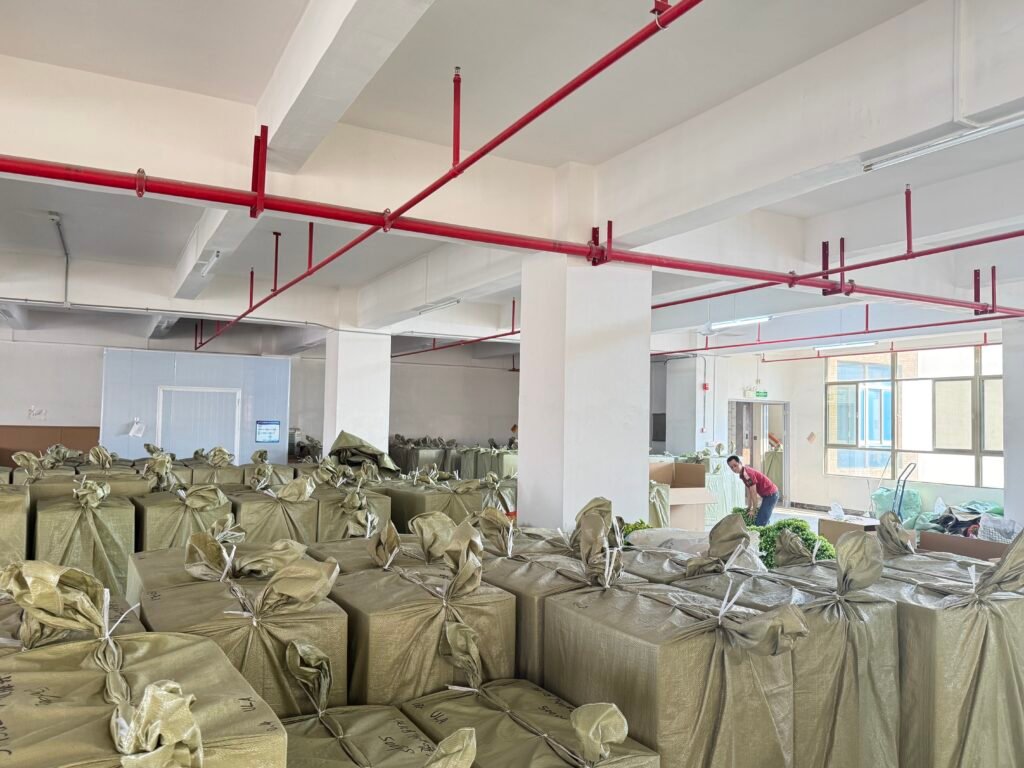
Search “wholesale artificial flowers” and you’ll find hundreds of suppliers who all look nearly identical: the same catalogue-style photos, the same promise of “factory price,” the same MOQ ranges. What actually separates a profitable order from an expensive mistake almost never shows up on the product page. It’s in the details — how pricing is actually structured, what MOQ really means once customization enters the picture, how to tell a factory from a trading company, and what your unit price turns into once freight and duties are added.
This guide walks through each of those decisions in order, using current market benchmarks rather than guesswork, so importers, distributors, and retailers can plan a first order with realistic numbers.
Worth noting as backdrop: independent market reports indicate continued international demand for artificial flowers, although published estimates vary by product scope and methodology. Growth is commercial-led — hotels, retailers, and event companies are the fastest-expanding segment, which means more buyers than ever are placing exactly the kind of first wholesale order this guide is written for.
What You’re Actually Paying For: Wholesale Pricing by Material
Unit price rarely tells the full story, because artificial flower pricing is driven almost entirely by material, not brand. Three tiers show up consistently across the market:
| Material Tier | Typical Use Case | Approx. Wholesale Price* | Notes |
| Plastic / PE / foam | Mass décor, budget events, high-volume retail | Lowest cost per unit | Less realistic up close; best for distance viewing or short-term use |
| Polyester / fabric silk-blend | General retail, everyday arrangements | Mid-range | Best balance of realism, durability, and cost for most retail buyers |
| Real silk / real-touch latex | Premium retail, hospitality, high-end events | $3.00–$8.00+ per stem/unit | Most lifelike; used where buyers or end customers inspect product up close |
*Prices vary by design complexity, stem count, and order volume — treat these as directional, not as a quote.
Two pricing mechanics matter more than the number on the listing:
Volume breakpoints. Most factories build in step-discounts, with the first meaningful price break around 500 units per design and a further one at full-container volumes. If a supplier quotes a flat price regardless of quantity, ask why — it usually means you’re dealing with a middleman working off a fixed markup rather than a factory with real production tiers.
Landed cost, not unit cost. The number on the invoice is not what the product actually costs you. For example, a stem quoted at $1.00 FOB might land at $1.25–$1.40 once ocean freight, duty, and handling are added for a typical mid-size order — while a supplier quoting $0.90 but routing through a slower, costlier shipping lane can end up more expensive by the time it reaches your dock. Ask every supplier for freight and duty estimates alongside their product quote, not after you’ve already decided.
MOQ: What’s Normal, and What’s Worth Questioning
Minimum order quantities in this industry typically run 50 to 500 pieces per design or color, with the exact figure depending on the product — a large hanging installation piece often carries a lower MOQ than a small flower head sold by the thousand.
Where MOQ gets more complicated is customization. Adding your own packaging, a printed logo, or a private-label design usually pushes the minimum higher than a standard reorder, since the factory is setting up a production run specifically for you. That’s normal, not a red flag — it’s the cost of a dedicated line versus one already running your item.
What is worth questioning:
- A supplier who won’t discuss samples below a very large minimum (several thousand units). That’s usually a factory sized for enormous accounts, not one set up to work with a growing business.
- A supplier who can’t explain why their MOQ is what it is. A real factory can walk you through the production math — machine setup time, minimum fabric roll length, dye-lot minimums. A reseller working off someone else’s stock often can’t.
- No way to test the product before committing. Whether it’s a low-cost sample or a small mixed-carton first order, you should be able to see and touch the actual material before placing a full order.
Vetting a Supplier: Factory-Direct vs. Trading Company
This is the highest-leverage decision in the entire process — it affects your price, your quality consistency, and whether you get a straight answer when something goes wrong.
Ask for proof of production, not just photos. A short video call showing the actual production floor, or dated photos of your specific product mid-run, is easy for a real factory to provide. A trading company usually can’t, because it doesn’t control the floor.
Test material knowledge. Ask something specific — the practical difference between PE and real-touch latex, or why one rose style costs three times another. A factory answers in seconds. A reseller often stalls or gives a generic answer.
Confirm certifications for commercial use. If your buyers include hotels, malls, offices, or any public venue, fire-retardant and UV-resistance certification isn’t optional in many jurisdictions. A supplier who can’t produce test reports on request is a liability, not a bargain.
Check the payment structure. The standard arrangement across the industry is a deposit — commonly around 30% — to start production, with the balance due before shipment. Being asked for 100% of a first order upfront, with no sample stage and no production updates, is one of the more reliable warning signs you’ll come across.
Use a trade fair or live call as a tiebreaker. If two suppliers look equally good on paper, a factory tour — in person at a sourcing fair like the Canton Fair, or over video call — usually settles it fast.
Shipping and Landed Cost: Sea, Air, and the Real Total
Freight is where a well-priced order can quietly turn into an expensive one, mostly because first-time buyers compare unit prices without comparing shipping structures.
| Mode | Typical Cost (China → US, indicative) | Transit Time | Best For |
| LCL (shared container) | Roughly $80–160 per CBM, plus origin/destination handling | ~10–25 days | Orders under ~12–15 CBM |
| FCL (full container) | Roughly $2,000–4,500 per container, size and season dependent | ~18–40 days | Orders above ~12–15 CBM |
| Air freight | Roughly $3–8 per kg | 2–5 days | Samples, urgent restocks, small high-value orders |
| Express courier | Highest per-kg cost | 2–4 days | Sample shipments and very small parcels only |
Ocean freight rates swing hard by season — expect noticeably higher pricing in the pre-holiday peak (roughly Q3 through Chinese New Year) than in the quieter months, and to move further during periods of broader freight market disruption. Always confirm a current quote with your supplier or forwarder rather than budgeting off an old rate.
Choosing an Incoterm shapes how much control — and how much work — you take on:
- EXW — you arrange everything from the factory gate onward. Lowest quoted price, most responsibility.
- FOB — the supplier delivers to the port; you or your forwarder handle the ocean leg onward. The most common choice for first-time buyers who want visibility without managing the whole chain.
- CIF — the supplier arranges freight and insurance to your destination port. Convenient, though you give up some ability to shop the freight rate yourself.
- DDP — all-in, duties included. The simplest option if you’d rather not touch customs at all, usually at the highest per-unit cost.
On duties: artificial flowers are generally classified under HS code 6702 — plastics under 6702.10, other materials under 6702.90. The applicable rate depends on material and destination market, and for US-bound shipments in particular, trade policy has shifted more than once over the past year. Don’t estimate this yourself — ask your customs broker or freight forwarder for the current landed rate before finalizing your budget, and build in a buffer.
Your First-Order Checklist
- Shortlist 2–3 suppliers and confirm factory-direct status by video call or trade fair visit.
- Request samples of your actual target product — not just catalogue photos.
- Get full landed cost, not just unit price: ask for freight and duty estimates alongside the quote.
- Confirm MOQ for standard versus customized orders before you finalize packaging or branding.
- Put payment terms in writing — deposit percentage and balance timing — before production starts.
- Ask for pre-shipment photos or video before the order leaves the factory.
- Choose your Incoterm based on how much of the logistics you actually want to manage.
- For any seasonal peak — holidays, wedding season — place the order 2–3 months before you need stock on shelves.
Quick Answers
What’s a typical MOQ for wholesale artificial flowers? Most factories work within 50–500 pieces per design; customized orders — your logo, packaging, or colors — usually sit at the higher end of that range or above.
Sea freight or air freight? Sea for anything beyond a sample order; the per-kilogram cost difference is substantial. Air only earns its premium for samples, urgent restocks, or small, high-value shipments.
FOB or DDP? FOB if you want visibility and are comfortable working with a forwarder. DDP if you’d rather pay a bit more per unit and skip the customs process entirely.
How do I know if a supplier is really a factory? Ask for a live video walkthrough of production and one specific material question. A real factory answers both without hesitation.
Is a very stock-based ordering always better? Not necessarily — it can also mean you’re buying from a reseller rather than a factory. Stock-aware ordering paired with real factory access is the combination worth looking for.
Do I need fire-retardant or UV certification? If your buyers include hotels, malls, offices, or outdoor and public installations, yes. Ask for test reports up front rather than assuming standard stock already meets commercial code.
A Note from Shantou
We wrote this guide the way we’d want a buying guide written for us — with real numbers, not just reassurance. That same approach carries into how we quote at PJTL: your price breakdown separates product cost from freight so you can see exactly what you’re paying for, in-stock products can support mixed-SKU test orders without a product MOQ, subject to carton multiples, and the sample fee is paid upfront and refunded after the first qualifying bulk order has been paid in full and delivered. In-stock orders normally need 3 to 7 working days for QC and packing, out-of-stock standard production normally needs 20 to 35 working days, and custom/OEM production normally needs 30 to 45 working days after sample approval, and we reply within 24 hours. If you’re building a wholesale buying program around any of this, we’re glad to walk through the numbers with you directly.
Ready to Start?
Tell us what you’re looking for. We’ll get back to you within 24 hours with pricing, availability, and a sample offer.